

Diastasis Recti: What It Is, Why It Happens, and How to Treat It

Diastasis Recti: What It Is, Why It Happens, and How toTreat It
If you've ever noticed a soft bulge running down the middleof your stomach — especially when you sit up, do a crunch, or hold your baby for too long — you may be dealing with something called diastasis recti. It'sincredibly common, and the good news isthat it's very treatable.
What Is Diastasis Recti?
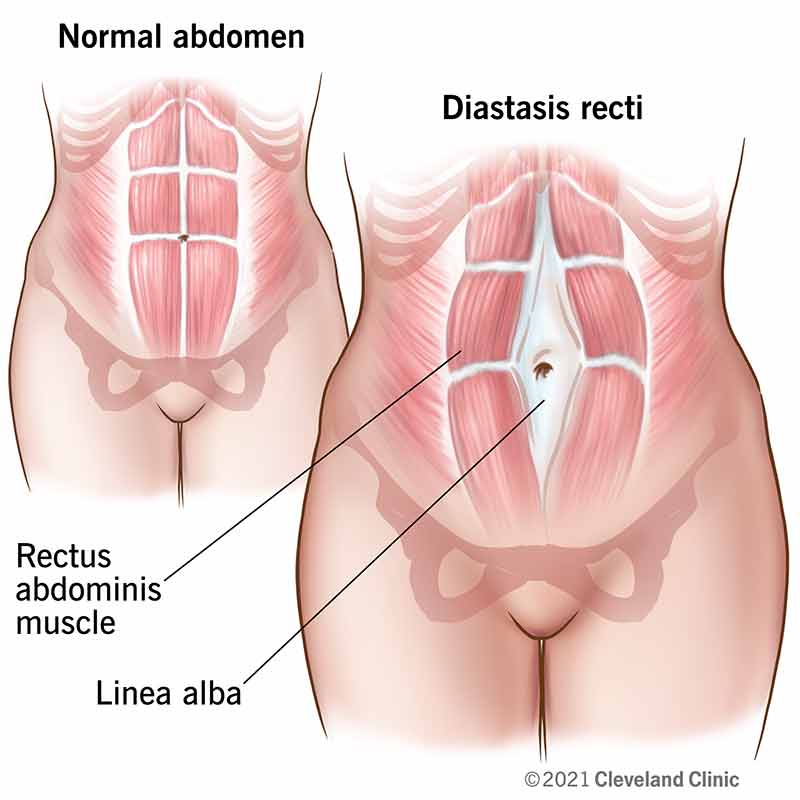
Picture your abdominal muscles as two long vertical stripsrunning down the front of your stomach, one ones that make up a"six-pack." Down the middle, holding those two strips together, is astrip of connective tissue called the linea alba.
During pregnancy, significant weight gain, or repeated heavystraining, that connective tissue can stretch out and thin — kind of like anoverstretched rubber band. When that happens, the two vertical muscle stripsdrift apart and create a gap in the middle. That gap is diastasis recti.
It's not a hernia, and it's not a muscle tear. It's awidening and weakening of the tissue that holds your core together.
Who Gets It?
Diastasis recti is often thought of as a"postpartum" issue, and it's true that more than half of women noticeit after having a baby. But it's not limited to new moms:
- It's common in men too, especially with age or weight gain around the midsection
- It can develop after major weight loss or weight gain
- It's common toward the end of pregnancy for nearly all women. It can close back up on its own after delivery, but it doesn’t always.
How Do You Know If You Have It?
The classic way to check is simple: lie on your back, bendyour knees, and do a small crunch or lift your head while pressing your fingersalong the middle of your stomach. If you can feel a gap between the two musclestrips, that's the diastasis.
Generally speaking, a gap of about 2 centimeters (roughlytwo finger-widths) or more is considered a true diastasis, though doctors don'tall agree on the exact cutoff, and where you measure (above, at, or below the belly button) matters too. Some providers use ultrasound for a more precisemeasurement, especially if surgery is being considered.
Why Should You Care? It's Not Just Cosmetic
Diastasis recti isn't only about how your stomach looks.When your core muscles are pulled apart like this, your whole "trunk" l oses some of its natural support system. This can show up as:
- A visible bulge or "pooch" that doesn't go away with diet or normal ab exercises
- A feeling that your core is weak or unstable
- Lower back pain, since your abdominal muscles normally help support your spine
- In some cases, a connection to bladder leakage (urinary incontinence) or pelvic floor issues
If left untreated, these issues tend to stick around.
Treatment Options
The right treatment really depends on how significant theseparation is and what your goals are. Here's the general roadmap:
1. Core-Focused Physical Therapy and Exercise
For mild-to-moderate cases, targeted exercises that focus onthe deep core muscles (not traditional crunches, which can actually make thingsworse) are the standard starting point. A physical therapist who specializes inpostpartum or core recovery can build a program tailored to you. This approachtakes consistency and time, often months, and results vary quite a bit fromperson to person.
2. Non-Surgical Muscle Stimulation
For patients who want a non-invasive option that speeds up strengthening technologies like Emsculpt Neo have become a popular option. More on this below.
3. Surgical Repair
For more severe or symptomatic cases, especially wherethere's a large gap, a related hernia, or the bulge significantly affectsquality of life — surgical repair (often called a "plication,"sometimes done along with a tummy tuck) may be recommended. This involvesstitching the muscles back together to close the gap. Studies show this canmeaningfully improve how the abdomen functions and how patients feel day to day.Like any surgery, it comes with recovery time and some risk of complications,so it's typically reserved for more significant cases after conservative options have been tried.
A Closer Look: Emsculpt Neo for Diastasis Recti
Emsculpt Neo is a non-invasive, in-office treatment that hasgained a lot of attention specifically for diastasis recti, with real clinicaldata behind it.
How it works: Emsculpt Neo combines two technologiesin one session — a high-intensity electromagnetic field (called HIFEM) thatforces your abdominal muscles into powerful, involuntary contractions, plusradiofrequency heat that targets the fat layer sitting over those muscles. In asingle 30-minute session, your core muscles go through roughly 20,000contractions, far more than you could ever do through voluntary exercise alone.Think of it as an intense, hands-free strength-training session for your deepcore muscles, combined with a fat-reduction treatment.
What the research shows:
- A published study in the Journal of Lasers in Surgery and Medicine found an average 18.6% reduction in fat thickness, a 15.4% increase in rectus abdominis (core) muscle thickness, and roughly a 10.4% reduction in the actual diastasis gap after a treatment course.
- A sham-controlled randomized trial published in Plastic and Reconstructive Surgery (2022) — meaning it was compared against a "fake" treatment to control for placebo effect — found the combined HIFEM + radiofrequency approach produced a 24.2% increase in rectus abdominis muscle thickness and a 28.3% reduction in fat thickness at three months.
- Manufacturer clinical data on the Neo platform specifically documents roughly a 19% reduction in diastasis gap width following a standard treatment course.
- Most patients start noticing changes within a few weeks, with the biggest results typically showing up 2–3 months after finishing treatment, as the muscle-building and tissue-remodeling effects continue to develop.
Who it's a good fit for: Emsculpt Neo tends to workbest for mild-to-moderate diastasis, and it's especially appealing for patients who want a non-surgical option with no downtime, you can walk in, have yoursession, and go straight back to your day. Many providers also recommendpairing it with a physical therapy or core-strengthening program for the best,longest-lasting results.
What it isn't: Emsculpt Neo is not a replacement forsurgery in severe cases, and it won't help if there's an underlying hernia, that needs to be ruled out by your provider first. It's best thought of as a way to accelerate and enhance the muscle-strengthening process, not a magic fix that skips the fundamentals of a healthy core.
The Bottom Line
Diastasis recti is common, it's not something you have to just "live with," and there's a real range of treatment options, from targeted exercise, to advanced non-surgical technology like Emsculpt Neo,to surgical repair for more significant cases. If you're noticing a persistent bulge, core weakness, or back pain that doesn't seem to be improving, the first step is simply getting evaluated by a provider who can measure the separation and help you figure out which path makes the most sense for you.
This article is for general educational purposes and isn't a substitute for a one-on-one evaluation. If you think you may have diastasis recti, schedule a visit so we can assess your specific situation and talk through the treatment options that fit your goals.
Read More Blogs!
Stay updated with the latest blog posts and engage with our community.
Are you ready to experience a new kind of healthcare? At Hikma Integrative Healthcare in Conroe, TX, we believe in treating the whole person—mind, body, and soul. We combine modern medicine with a compassionate approach to guide you on your journey to lasting vitality. Visit us today to discover a partner in your wellness and begin your path to a healthier, happier you.